
Tracing Former Clarke County Owners
Start with a current grantee. Then work toward the prior grantor. The Circuit Clerk publishes no cutoff year for its modern online index, so an online miss does not mean the oldest deeds are unreachable. The Library of Virginia documents the older Clarke County deed books and index runs. Those years describe historical microfilm collections rather than the current web portal.
| Source | Years It Covers | Where Held | What It Shows |
|---|---|---|---|
| Current deed index | Modern cutoff not verified | Circuit Clerk / COVERS-SRA | Recorded party names and instruments |
| Deed Books A-Z | 1836-1901 | Clerk and Library of Virginia microfilm | Historic conveyances by book |
| General grantor/grantee indexes | 1836-1934 | Clerk and Library of Virginia microfilm | Party-name path into deed references |
| Release Deed Book 1 | 1884-1919 | Library of Virginia finding aid | Recorded releases and related entries |
Start at the Clerk's current index. Confirm how Clarke handles remote access for recent transfers. Earlier owners come from the LVA grantor and grantee reels. Pull the deed book reference next. Probate and fiduciary records help when land passed through an estate, while Historical Association maps and old newspapers can connect a name to a place.
Clarke County Index Coverage
The Clerk's county page publishes no modern index cutoff. Virginia's COVERS/SRA image service sits behind agreements and fees, and the public notice does not say which Clarke years or field labels it includes. Ask the Clerk directly. Treat a missing online result as unknown, not as proof.
The Library of Virginia's microfilm holds verified historic indexes covering 1836 through 1934. That run is separate from today's remote access. Write down the last instrument in one source. Its grantor, grantee, legal description, and book reference carry the search into the next.
Clarke County Deed Books and Reels
Book A starts the run at 1836. The LVA finding aid carries the alphabet forward to Book Z, dated 1899 to 1901, then lists general grantor and grantee indexes in A-K and L-Z divisions through 1934. Some reels circulate through interlibrary loan. Ask the holding library first.
The Library of Virginia Clarke County finding aid names the recorded collections and their years.
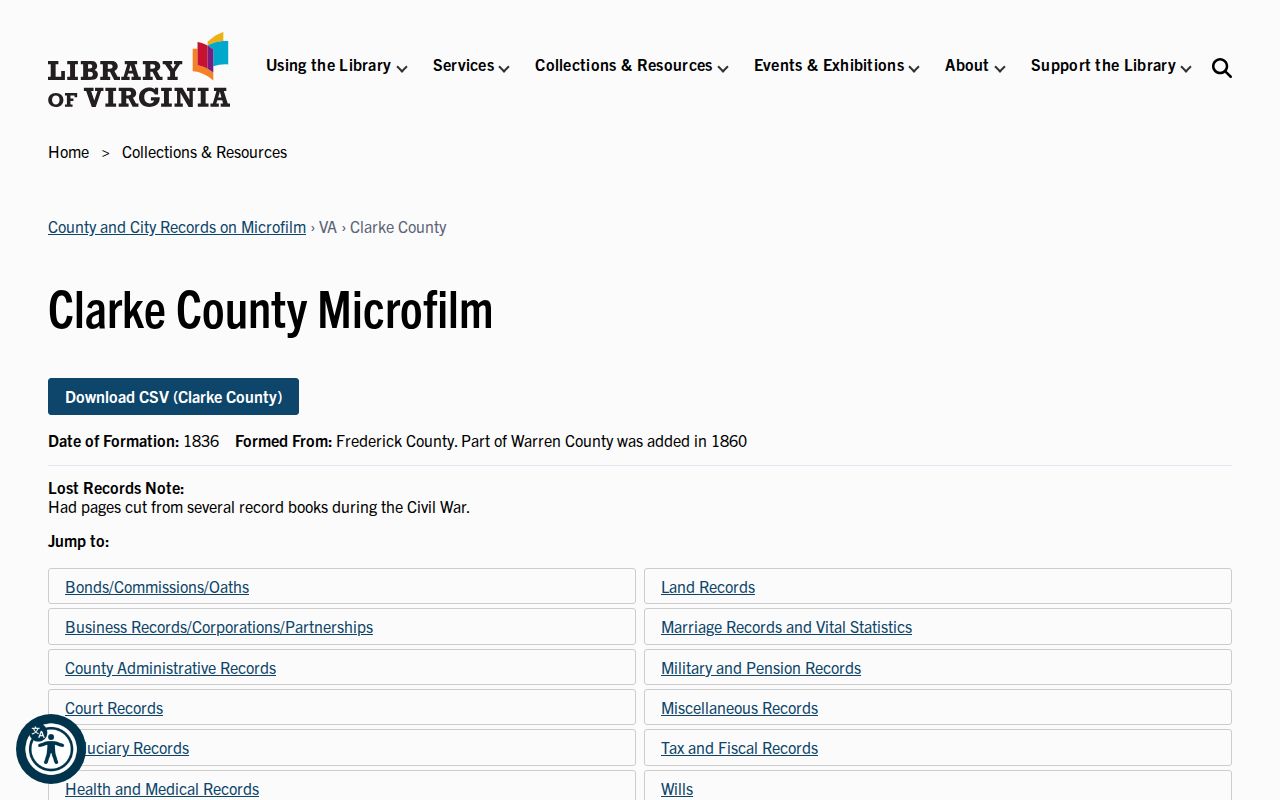
Locate the year and parties on the reel listing. Then verify the cited deed in the volume itself or with the Circuit Clerk.
Clarke County Civil War Record Gaps
Some Clarke record books lost pages during the Civil War. The Library of Virginia says so plainly. A cut page can break a clean deed chain. Neighboring index entries, later deeds that cite the missing book, court and chancery records, tax material, estate papers, and adjoining-owner instruments all help rebuild the gap. A missing page is not proof.
The book sequence also skips a letter between I and K in the LVA list. Record the volume and year a citation actually names. Filling a missing letter from memory invites error. A later deed sometimes preserves the reference that restores the missing segment.
Walk a Clarke County Deed Chain Backward
A deed chain links every conveyance for one tract. Start at the newest deed. Its grantee points to the grantor who conveyed the land. Search that earlier owner as a grantee next. Names alone will not carry you far, because parcel splits, road changes, and estate names can make the same land look different across decades. Compare the legal description at every transfer.
| Transfer point | Grantor to grantee | Instrument | Book/page or number |
|---|---|---|---|
| Most recent deed | Copy from the recorded instrument | Read the deed type | Record the citation |
| Prior conveyance | Current grantee's earlier grantor | Compare the land description | Follow the index reference |
| Earlier owner | Repeat the grantee-to-grantor step | Check estate or trustee authority | Continue in book or reel |
- Find the latest deed into the current grantee, using the parcel and legal description to confirm identity.
- Record its grantor, recording date, type, and citation.
- Search that grantor as the earlier grantee and compare the same land description.
- Move from the modern index to LVA microfilm or a Clerk-held book when needed.
- Grantor
- The party who conveyed the interest in a deed.
- Grantee
- The party who received that interest.
- Chain of title
- The linked record of conveyances for the same land.
- Legal description
- The recorded text that defines the land more precisely than a street address.
Clarke County Estate Transfers
Probate explains many title changes in Clarke County. The Circuit Clerk holds the wills and estate files, along with executor and administrator appointments, inventories, accountings, appraisals, sale orders, and deeds. A transfer may follow a will, a commissioner sale, or an estate administration rather than an ordinary sale. Search the last deed. Note the owner it names. The Clerk can then point you to the estate record behind the transfer.
Death certificates sit with the Virginia Department of Health. Death, marriage, and divorce records become public after 25 years; birth records open after 100. Certified copies generally require an eligible applicant, ID, and a $15 search or certificate fee. The Virginia vital-record genealogy page explains those periods.
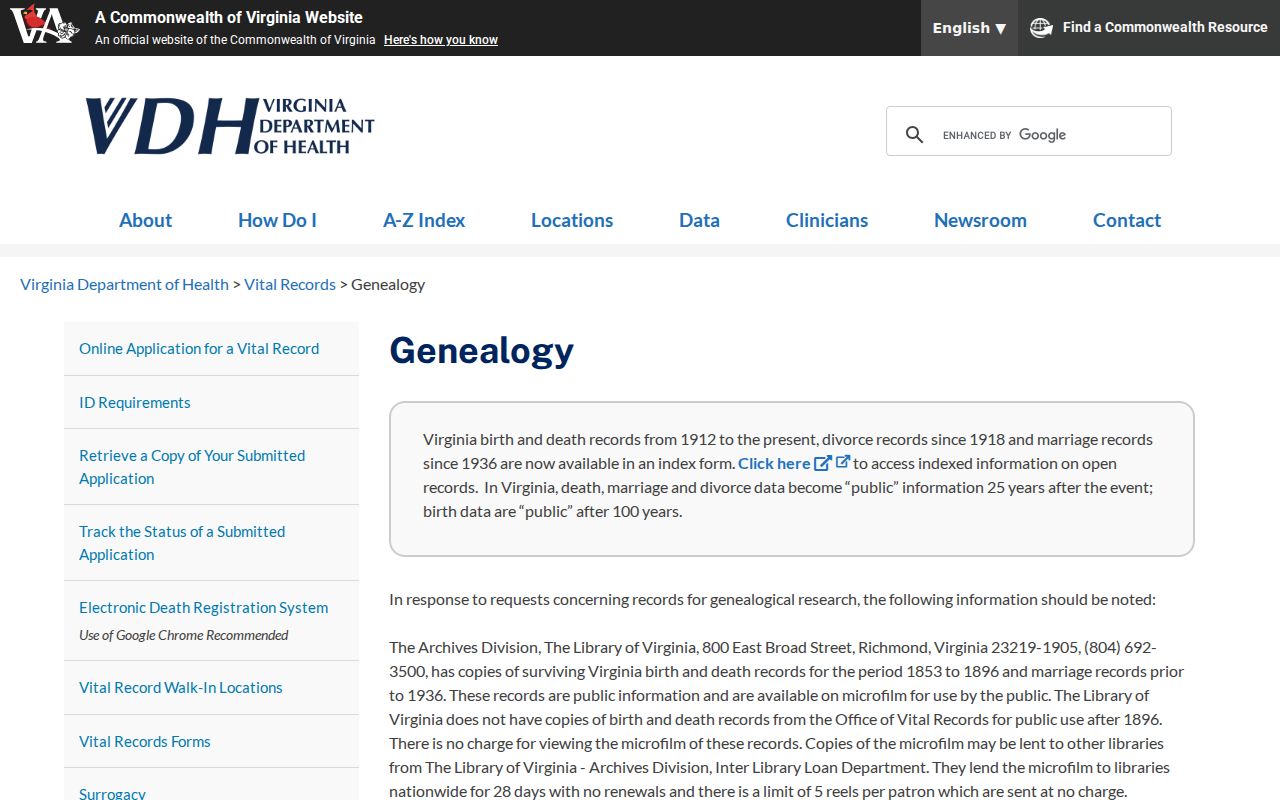
A death date is a probate lead; confirm the deed.
Clarke County Farm and Estate Names
Old deeds and plats in Clarke County often carry estate names instead of addresses. Carter Hall, Annefield, and Audley appear in historic Clarke sources. So do Fairfield, Farnley, Gaywood, Goshen, and Long Branch. Longwood, Lucky Hit, Melrose, Rosemont, and Mount Airy show up there too. You will meet them in old deed records, plats, DHR surveys, maps, and newspaper notices. They make strong search terms. Just remember that few are current subdivisions. None by itself pins down a present parcel.
When an address fails to surface an older deed, change tactics. Try the farm name, a route number, an acreage figure, or the adjoining owners. The Historical Association keeps maps, drawings, and newspaper files. It also holds photographs, church and burial records, yearbooks, and local-history Proceedings. Use those materials to tie a family to a place. Then go back to the Clerk's land records for real proof of a transfer.
Clarke County Land Before 1836
Clarke County split from Frederick County in 1836. That date matters for anyone tracing an older parcel. Land held before the split may sit in Frederick County records. Clarke's earliest deed book opens in 1836. So before assuming the local books are incomplete, check which jurisdiction held the land at the time.
Each link in your chain should preserve five things: the date, the grantor, the grantee, the legal description, and the book reference. Then compare that historical tract against today's tax map number. Use plats, adjoining owners, and estate names to do it. Modern parcel lines often reflect later splits or merges. The current map key is a guide, not a substitute for the old description itself.
How Far Clarke County Ownership Records Reach
Clarke County deed records start in 1836. The LVA finding aid documents deed books through 1901 and party indexes through 1934. It does not set the modern online cutoff. When a portal search runs dry, keep going. The Clerk's book reference and the LVA reels help. Related probate, court, tax, plat, or neighboring deed material can extend the chain. Land from before 1836 calls for a search of Frederick County too.
Some Clarke record-book pages were cut during the Civil War. A gap can be real damage rather than a missing transfer. Later deeds that cite the instrument can help. Adjacent grantor and grantee entries, chancery records, estate papers, and historical maps can bridge the hole. For a single deed copy, start there. For portal access terms too, see the Clarke County deed records page.
Lawful use. Trace former owners for a property's history, family research, or due diligence. Do not use records to track, threaten, stalk, harass, or harm a living person.